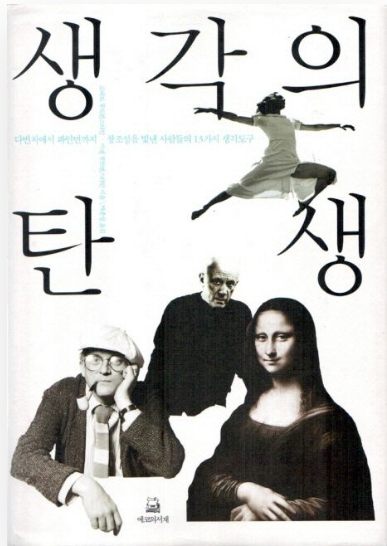
- 책 제목 : 생각의 탄생(Sparks of Genius)
- 저자 : 로버트 루트번스타인, 미셸 루트번스타인 공저
- 출판사 : 에코의 서재, 2007
- 장르 : 인문학
- 개요 : 상상력을 학습하는 13가지 도구에 대한 소개
- 선정 이유 : 학교 연구실 선배님께서 추천해 줌
- 읽기 시작한 날짜 : 2023-10-31
1. 오늘 읽은 챕터 정리
p190 생각도구 6 유추(analogizing)
The book named as Sparks of genius from rober root berstrein,
The book named "Sparks of Genius" by Robert Root-Bernstein
this book introduce us 13 ways to think creative.
this book introduces us to 13 ways to think creatively.
And i'd like to share information from the chapter that i read today.
And I'd like to share information from the chapter that I read today.
this chapter's main topic was analozing.
This chapter's main topic was analogizing.
let me tell about the analougous first.
Let me tell about the analogous first.
analoguos means to make an analogy which is used when a shape cannot be numerically quantified for precise expression. In other words, it's used to represent an entity that is uncertain but exists.
Analogous means to make an analogy, which is used when a shape cannot be numerically quantified for precise expression.
At this point, you guys may know the digital as a opposite of "analog".
At this point, you may know digital as the opposite of "analog".
for example, there are 2 scales, one is digital scale, and the other is analog scale.
For example, there are 2 scales, one is a digital scale, and the other is an analog scale.
if we try to weight something with both, then we could see clear number the weight of the thing on the screen of the digital scale. but on the other hands, we have to assume the weight looking at the rod of the scale poining.
If we try to weigh something with both, then we could see the clear weight of the thing as a number on the screen of the digital scale, but on the other hand, we have to assume the weight by looking at the rod of the scale pointing.
that's so "analogical way", right?
That's the "analogical way", right?
And we also can find all the analogs in the nature and our lives.
And we can also find all the analogies in nature and our lives.
How? let me introduce the Newton who found out the concpet of "Gravity".
How? Let me introduce Newton, who discovered the concept of "Gravity".
He thought there would be a power to drag the moon to the earth at the moment when an apple falling down to the ground.
what he did was discovering functional similarities or matching internal relationships between 2 or more phenomena, and that's the analogizing.
What he did was discover functional similarities or match internal relationships between two or more phenomena, and that's analogizing.
Luckily they said how to raise the skill to analogize.
Fortunately, they explained how to improve the skill of analogizing.
We should not ask 'What is it?' but rather 'What could it be?' when we encounter objects, phenomena, or processes.
Through this form of analogy, we can uncover the hidden functions and purposes. A precise understanding of functional purposes will enable us to develop an insight into novelty.
The book named "Sparks of Genius" by Robert Root-Bernstein.
This book introduces us to 13 ways to think creatively.
And I'd like to share information from the chapter that I read today.
This chapter's main topic was analogizing.
Let me tell about the analogous first.
Analogous means to make an analogy, which is used when a shape cannot be numerically quantified for precise expression.
At this point, you may know digital as the opposite of "analog".
For example, there are 2 scales, one is a digital scale, and the other is an analog scale.
If we try to weigh something with both, then we could see the clear weight of the thing as a number on the screen of the digital scale, but on the other hand, we have to assume the weight by looking at the rod of the scale pointing.
That's the "analogical way", right?
And we can also find all the analogies in nature and our lives.
How? Let me introduce Newton, who discovered the concept of "Gravity".
He thought there would be a power to drag the moon to the earth at the moment when an apple falling down to the ground.
What he did was discover functional similarities or match internal relationships between two or more phenomena, and that's analogizing.
Fortunately, they explained how to improve the skill of analogizing.
We should not ask 'What is it?' but rather 'What could it be?' when we encounter objects, phenomena, or processes.
Through this form of analogy, we can uncover the hidden functions and purposes. A precise understanding of functional purposes will enable us to develop an insight into novelty.
2. Question for the group
Which one do you prefer, 'analog' or 'digital'?
3. Key points
4. words
| Words | Means | Example |